> ## Documentation Index
> Fetch the complete documentation index at: https://docs.mezmo.com/llms.txt
> Use this file to discover all available pages before exploring further.
# Search Log Fields
> Search parsed and nested log fields using value, comparison, existence, term-match, and case-sensitive operators, plus metadata and line-size searches.
Mezmo provides several capabilities for searching fields in your logs. In this topic you'll find information on nested field searches, searching by field comparison, searching for the existence of fields, and general and exact term field searches.
## Access Search
1. Log in to [app.mezmo.com](https://app.mezmo.com).
2. In the **Search** box at the bottom of the log viewer, enter your search terms.
3. Select the **Timeframe** that you want to search.
4. Select if you want to search **Live** log data, or historical.
5. In the **Viewer Tools** menu, enter any text you want highlighted in the search results.
 ## JSON Field Search
To search for a field with a particular value, use a colon to separate the field and value.
This example will return all parsed log lines with the field `response` with a value of `404`.
```bash theme={null}
response:404
```
### Nested Field Search
To search for a nested field, use periods to separate each nested field.
This example will return all log lines containing the key:value structure `{ "user": { "id": 12345 }}.`
```bash theme={null}
user.id:12345
```
## Filters
Using the same field search syntax, you can also set filters directly in the search bar.
This example will return all log lines that originate from the source `myawesomehost` and not from the app `mycoolapp`.
```bash theme={null}
host:myawesomehost -app:mycoolapp
```
## Metadata
With the REST API or Node.js library, you can upload a metadata object as part of a log line's context. To search for field values contained in the metadata object, use the `meta` prefix.
This example will return all log lines containing the context object with the key:value structure `{ "status_code": 404}.`
```bash theme={null}
meta.status_code:404
```
## Field Comparison Operators
For parsed fields with a numeric value, we support the following operators:
```bash theme={null}
* =
* <
* >
* <=
* >=
```
To search for parsed fields matching comparison operators, use a colon followed by the comparison operator.
```bash theme={null}
response:>=400
```
## Compound Field Comparison Search
To form a compound field search query using comparison operators, use a colon followed by parentheses.
This example will return all log lines with the field `response` with values greater than or equal to `400`, less than `500`, and not `404`.
```bash theme={null}
response:(>=400 <500 -404)
```
## Case-Sensitive Field Search
To search for a case-sensitive parsed field, use a colon followed by an equal sign `=`.
This example will return all log lines with the field `name` with the case-sensitive string value `camelCasedName`.
```bash theme={null}
name:=camelCasedName
```
## Existence Field Search
To search for the existence of a parsed field, use a colon followed by the asterisk `*.`
This example will return all log lines that have a value for the `user` field.
```bash theme={null}
user:*
```
## Term Match Field Search
To search for a term match for a field value, use `==`.
This example will return all lines with the exact name field value of `bob`, and will not match `bobby`.
```bash theme={null}
name:==bob
```
## Term Match Case-Sensitive Field Search
Prefix search is set by default for all string fields. To search for an **exact** match for a field value, use `===`.
This example will return all lines with the exact name field value of `Bob`, and will not match `bob` or `Bobby`.
```bash theme={null}
name:===Bob
```
## Line Size Search
You can search for log lines by size by using the `mezmo_line_size` field annotation. This example will return lines with a line-size greater than 4000 bytes.
```bash theme={null}
_mezmo_line_size:>4000
```
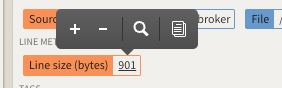
You can create a search based on the size of specific log line by clicking the **Line size** value in the Log Viewer.
## JSON Field Search
To search for a field with a particular value, use a colon to separate the field and value.
This example will return all parsed log lines with the field `response` with a value of `404`.
```bash theme={null}
response:404
```
### Nested Field Search
To search for a nested field, use periods to separate each nested field.
This example will return all log lines containing the key:value structure `{ "user": { "id": 12345 }}.`
```bash theme={null}
user.id:12345
```
## Filters
Using the same field search syntax, you can also set filters directly in the search bar.
This example will return all log lines that originate from the source `myawesomehost` and not from the app `mycoolapp`.
```bash theme={null}
host:myawesomehost -app:mycoolapp
```
## Metadata
With the REST API or Node.js library, you can upload a metadata object as part of a log line's context. To search for field values contained in the metadata object, use the `meta` prefix.
This example will return all log lines containing the context object with the key:value structure `{ "status_code": 404}.`
```bash theme={null}
meta.status_code:404
```
## Field Comparison Operators
For parsed fields with a numeric value, we support the following operators:
```bash theme={null}
* =
* <
* >
* <=
* >=
```
To search for parsed fields matching comparison operators, use a colon followed by the comparison operator.
```bash theme={null}
response:>=400
```
## Compound Field Comparison Search
To form a compound field search query using comparison operators, use a colon followed by parentheses.
This example will return all log lines with the field `response` with values greater than or equal to `400`, less than `500`, and not `404`.
```bash theme={null}
response:(>=400 <500 -404)
```
## Case-Sensitive Field Search
To search for a case-sensitive parsed field, use a colon followed by an equal sign `=`.
This example will return all log lines with the field `name` with the case-sensitive string value `camelCasedName`.
```bash theme={null}
name:=camelCasedName
```
## Existence Field Search
To search for the existence of a parsed field, use a colon followed by the asterisk `*.`
This example will return all log lines that have a value for the `user` field.
```bash theme={null}
user:*
```
## Term Match Field Search
To search for a term match for a field value, use `==`.
This example will return all lines with the exact name field value of `bob`, and will not match `bobby`.
```bash theme={null}
name:==bob
```
## Term Match Case-Sensitive Field Search
Prefix search is set by default for all string fields. To search for an **exact** match for a field value, use `===`.
This example will return all lines with the exact name field value of `Bob`, and will not match `bob` or `Bobby`.
```bash theme={null}
name:===Bob
```
## Line Size Search
You can search for log lines by size by using the `mezmo_line_size` field annotation. This example will return lines with a line-size greater than 4000 bytes.
```bash theme={null}
_mezmo_line_size:>4000
```
You can create a search based on the size of specific log line by clicking the **Line size** value in the Log Viewer.
 You can also create graphs based on `mezmo_line_size` as described in [Create a Graph](/docs/create-a-graph).
## Colons
Since the colon is a reserved character for field search, quotes are required when searching for strings with colons in them.
This example will return all log lines with the string `response:` in them.
```bash theme={null}
"response:"
```
## Combining Operators
You can combine operators to make your search more specific. This searches first for logs scanned from`/var/log/syslog` or that contain the word `ERROR`, then limits the results to `node1.`
```bash theme={null}
source:node1 AND (file:/var/log/syslog OR ERROR)
```
This searches logs where the value stored in the status field is greater than 100 and less than 503.
```bash theme={null}
status:(>100 AND <= 503)
```
## Lists
Any whitespace between search terms is automatically interpreted as AND. For example, searching warning error returns logs containing both warning and error. The only exception is when using lists, which treat whitespace as a part of the search term. For example, searching `message:[file, exists]` will only search for instances of exists that are preceded by a space. Some other examples:
* `level:[warning,error]` will return as normal.
* `level:[warning, error]`with a space between warning and error, will search for entries of the field level which have "warning" or " error" with space included.
* `level:[warning,(error)]` will search for entries of the field level which have "warning" or "(error)" with parenthesis included.
You can also create graphs based on `mezmo_line_size` as described in [Create a Graph](/docs/create-a-graph).
## Colons
Since the colon is a reserved character for field search, quotes are required when searching for strings with colons in them.
This example will return all log lines with the string `response:` in them.
```bash theme={null}
"response:"
```
## Combining Operators
You can combine operators to make your search more specific. This searches first for logs scanned from`/var/log/syslog` or that contain the word `ERROR`, then limits the results to `node1.`
```bash theme={null}
source:node1 AND (file:/var/log/syslog OR ERROR)
```
This searches logs where the value stored in the status field is greater than 100 and less than 503.
```bash theme={null}
status:(>100 AND <= 503)
```
## Lists
Any whitespace between search terms is automatically interpreted as AND. For example, searching warning error returns logs containing both warning and error. The only exception is when using lists, which treat whitespace as a part of the search term. For example, searching `message:[file, exists]` will only search for instances of exists that are preceded by a space. Some other examples:
* `level:[warning,error]` will return as normal.
* `level:[warning, error]`with a space between warning and error, will search for entries of the field level which have "warning" or " error" with space included.
* `level:[warning,(error)]` will search for entries of the field level which have "warning" or "(error)" with parenthesis included.